


Costume and Textiles
The costume and textile collections at the Ulster Folk Museum hold objects that provide a vibrant and engaging record of lives lived and lost, industry at home, enterprise abroad, political upheaval and personal achievement.
The collections chart the massive growth of the linen industry in Ulster of the second half of the 1800s, and earlier enterprises in the spinning, weaving and decorating of cotton cloth.
Linen
The late 19th century boost to the linen industry was driven by the development of power looms and improvements to transport and communication. The significant shift from cottage industry to global domination produced challenges for some and rewards for many, underpinning much of the economic success of Belfast as a civic power at the start of the 20th century.
Collections of cloth samples and finished linens, photographic records and trade literature paint a very complete picture of the move from workroom to warehouse via international exhibitions of arts and industry.
Embroidery and lace
Embroidery on linen and cotton, lace making and embroidery in all its various forms are represented in collections of needlework sample books, pictures, costume and accessories dating from 1730 to present day. The creative output associated with these textile craft skills carries stories of developments in education in Ireland, famine relief work, and an outwork industry providing economic support for many thousands of women working in their own homes.
Regalia and flags
The collections include hundreds of objects reflecting aspects of political change, new allegiances, and divided loyalties. Regalia, flags and emblems, commemorative textiles, uniforms and badges provide a graphic record of conflicts experienced intensely at both local and global level, over the last 300 years. A small but significant collection of handkerchiefs includes some produced in prison during the early 1970s, a most turbulent time in Ulster’s recent past.
Costume and accessory
Costume and dress accessory collections at the Ulster Folk Museum include almost 10,000 objects spanning a period from 1760 to the late 1980s. From the smallest of baby’s bonnets to the grandest of wedding dresses and elaborately embroidered clerical vestments, each is a powerful and evocative prompt to recall stories of joy, of sadness, of belief, power and privilege.
A collection of transport uniforms, occupational dress, dance costumes, clerical vestments, and objects relating to motor cycle sport illustrate aspects of working life, religious practices and recreation in Ulster between 1900 and present day.
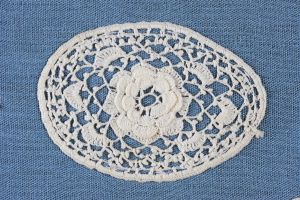
HOYFM.660.1972
Crochet lace sampler
Sampler

HOYFM.2013.74.57
Antimacassar

HOYFM.896.1979
blouse

HOYFM.381.1996B
Cap

HOYFM.89.1988
Doiley

HOYFM.381.1996D
Headdress

HOYFM.377.1977
Lace handkerchief

HOYFM.706.1971
Collar

HOYFM.713.1971
Collar

HOYFM.250.1969
Chainmail Purse

HOYFM.1193.1993
purse, ivory

HOYFM.2013.76.13
Bedcover

HOYFM.451.1987
Handkerchief

HOYFM.2014.176.3
Neck tie

HOYFM.2014.176.2
Shirt

HOYFM.2014.176.1
Waistcoat

HOYFM.2014.177.1
DRESS

HOYFM.304.1969
Pincushion

HOYFM.1275.1992B
Pincushion

HOYFM.1703.1970
Lace collar

HOYFM.3.1988
Blouse

HOYFM.388.1996
Dress

HOYFM.386.1996
Dress

HOYFM.1512.1987
blouse

HOYFM.2012.259.66
Linen proof cloth

HOYFM.2012.259.14
Linen proof cloth

HOYFM.2012.259.10
Linen proof cloth

HOYFM.2012.259.8
Linen proof cloth

HOYFM.2012.259.6
Linen proof cloth

HOYFM.2012.259.3
Linen proof cloth

HOYFM.2012.259.2
Linen proof cloth

HOYFM.2012.259.1
Linen proof cloth

HOYFM.381.1996C
Bag

HOYFM.381.1996A
Robe

HOYFM.370.1972
Blouse

HOYFM.1278.1992
Pincushion

HOYFM.2013.76.1
Bedcover

HOYFM.2012.259.27
Linen proof cloth

HOYFM.2012.259.24
Linen proof cloth

HOYFM.2012.259.23
Linen proof cloth

HOYFM.1301.1992
Pincushion

HOYFM.2012.259.16
Linen proof cloth

HOYFM.1169.1970
Bag

HOYFM.1286.1992
Pincushion

HOYFM.533.1971
Pincushion

HOYFM.212.1970
Pincushion cover

HOYFM.721.1971
Crochet lace

HOYFM.195.1969
Purse

HOYFM.1640.1993
chainmail purse

HOYFM.1635.1993
silk bag

HOYFM.1248.1993
card case

HOYFM.1199.1993
misers purse